Experiments
This page provides a comprehensive overview of the experiment suite validating the five axioms of Clock-Selected Compression Theory (CSCT). For exact definitions, loss functions, and equations, see the manuscript source in paper/main.tex.
Quick Navigation
| Experiment | Topic | Axiom Tested |
|---|---|---|
| EX1 | Single-Channel Waveform Discretization | A1 (Streams) |
| EX2 | Multi-Channel Relational Information | A3 (Multi-Clock) |
| EX3 | Codebook Size (K) Dependency | A2 (Simplex) |
| EX4 | Open vs Closed Regime | A4 (Irreversible Anchor) |
| EX5 | Feature Binding via Common Clock | A3 (Multi-Clock) |
| EX6 | Category Detection (Frozen Codebook) | A2 (Simplex) |
| EX7 | Relational Internal Time | A3 (Multi-Clock) |
| EX8 | Semantic Grounding | A2 (Simplex) |
| EX9 | Syntax Inference | A5 (Barycentric Syntax) |
EX1 — Single-Channel Waveform Discretization
Purpose
EX1 examines the fundamental discretization capability of CSCT at the peripheral processing level. This experiment tests whether SingleGate architecture can achieve stable discrete quantization of single-channel waveforms without requiring complex relational processing.
Hypotheses
- H1 (SingleGate Sufficiency): For single-channel waveforms with self-referential anchoring, SingleGate architecture will achieve low reconstruction error.
- H2 (MultiGate Redundancy): MultiGate architecture will perform worse than SingleGate on this task, despite having greater representational capacity.
- H3 (Waveform Generalization): The performance advantage of SingleGate will hold across diverse waveform types.
Task Design
The task discretizes a single continuous waveform into a sequence of discrete codes while minimizing reconstruction error. Nine waveform types ensure generalization:
| Waveform | Description |
|---|---|
| sine | Pure sinusoid — basic periodic discretization |
| chirp | Frequency sweep — time-varying frequency adaptation |
| am | Amplitude-modulated — envelope dynamics |
| fm | Frequency-modulated — instantaneous frequency changes |
| ecg | ECG-like with periodic sharp peaks — transient events |
| saw_bl | Band-limited sawtooth — asymmetric waveforms |
| composite | Sum of multiple frequencies — multi-scale representation |
| noisy | Sine + Gaussian noise — noise robustness |
| burst | Intermittent signal — onset/offset handling |
Method
| Parameter | Value |
|---|---|
| Anchor Configuration | Self-referential (y = x) |
| Codebook Size (K) | 8 |
| Transition Penalty (β) | 50 |
| Sequence Length (T) | 200 |
| Training Steps | 500 |
| Seeds | 20 per condition |
Metrics
- Reconstruction Loss (MSE): $\mathcal{L}_{\text{recon}} = |x - \hat{x}|^2$
- Transition Rate: Fraction of timesteps where discrete code changes
- Unique Codes: Number of distinct codes activated
- Code Entropy: Normalized entropy of code distribution
Results
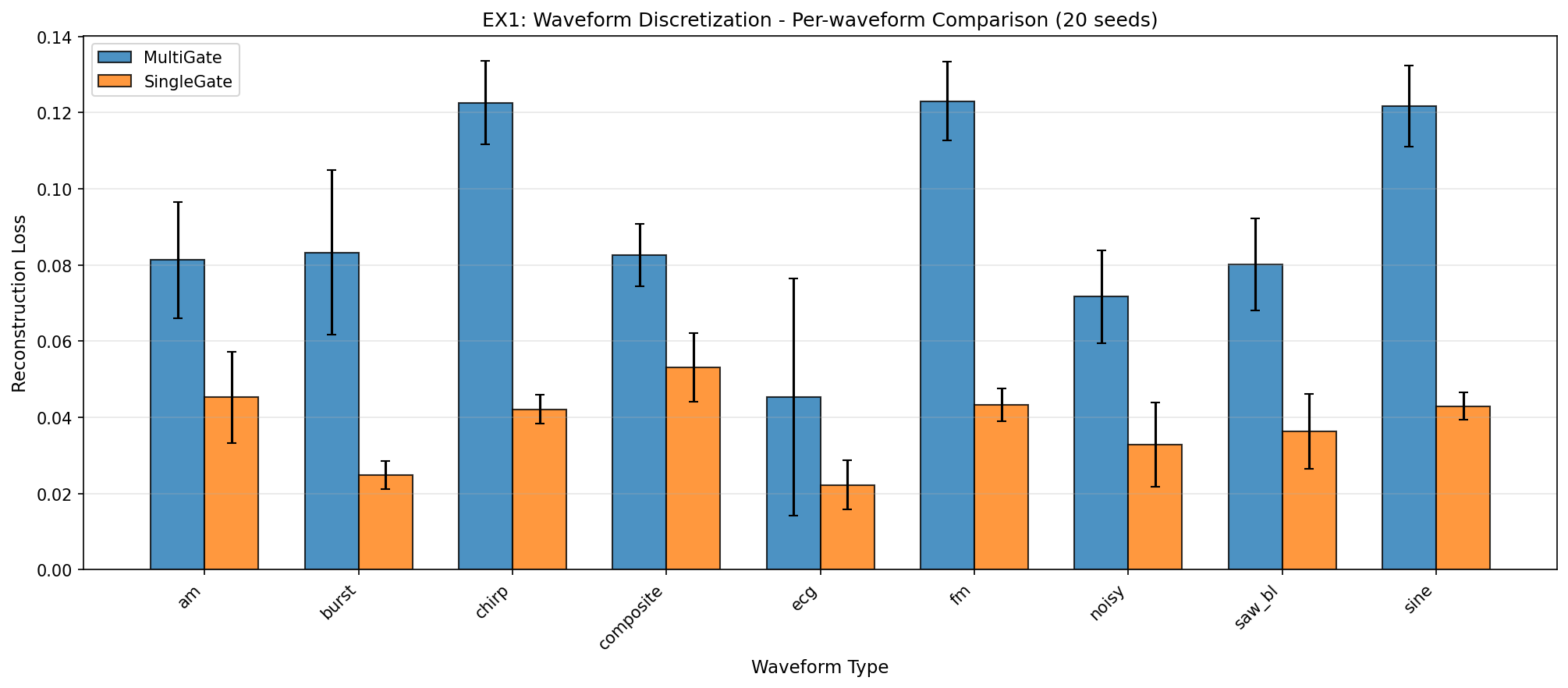
Aggregate Statistics (180 paired wave×seed trials):
| Architecture | Reconstruction Loss | 95% CI |
|---|---|---|
| SingleGate | 0.0381 | [0.0364, 0.0399] |
| MultiGate | 0.0902 | [0.0858, 0.0946] |
Paired difference: ΔRecon = 0.0521 (95% CI [0.0480, 0.0561]), d_z = 1.879
Per-Waveform Results (Click to expand)
| Waveform | Gate | Recon. Loss | Transition Rate | Unique Codes | Code Entropy | |----------|------|-------------|-----------------|--------------|--------------| | am | MultiGate | 0.081 ± 0.015 | 0.205 ± 0.046 | 4.30 ± 1.00 | 0.570 ± 0.115 | | am | SingleGate | 0.045 ± 0.012 | 0.231 ± 0.030 | 3.85 ± 0.73 | 0.571 ± 0.041 | | burst | MultiGate | 0.083 ± 0.021 | 0.201 ± 0.035 | 3.50 ± 0.92 | 0.405 ± 0.098 | | burst | SingleGate | 0.025 ± 0.004 | 0.215 ± 0.022 | 3.85 ± 0.48 | 0.440 ± 0.038 | | chirp | MultiGate | 0.123 ± 0.011 | 0.253 ± 0.040 | 4.80 ± 0.87 | 0.585 ± 0.078 | | chirp | SingleGate | 0.042 ± 0.004 | 0.250 ± 0.010 | 4.80 ± 1.03 | 0.592 ± 0.026 | | composite | MultiGate | 0.083 ± 0.008 | 0.071 ± 0.018 | 4.55 ± 0.92 | 0.527 ± 0.095 | | composite | SingleGate | 0.053 ± 0.009 | 0.099 ± 0.014 | 4.20 ± 0.60 | 0.580 ± 0.044 | | ecg | MultiGate | 0.045 ± 0.030 | 0.109 ± 0.020 | 4.55 ± 0.80 | 0.543 ± 0.100 | | ecg | SingleGate | 0.022 ± 0.006 | 0.074 ± 0.016 | 4.05 ± 1.36 | 0.374 ± 0.056 | | fm | MultiGate | 0.123 ± 0.010 | 0.189 ± 0.040 | 4.85 ± 0.96 | 0.590 ± 0.099 | | fm | SingleGate | 0.043 ± 0.004 | 0.184 ± 0.018 | 5.00 ± 0.77 | 0.616 ± 0.021 | | noisy | MultiGate | 0.072 ± 0.012 | 0.209 ± 0.088 | 4.20 ± 1.08 | 0.511 ± 0.111 | | noisy | SingleGate | 0.033 ± 0.011 | 0.198 ± 0.042 | 3.90 ± 0.70 | 0.549 ± 0.037 | | saw_bl | MultiGate | 0.080 ± 0.012 | 0.107 ± 0.047 | 4.05 ± 1.07 | 0.491 ± 0.100 | | saw_bl | SingleGate | 0.036 ± 0.010 | 0.089 ± 0.012 | 3.55 ± 0.59 | 0.549 ± 0.037 | | sine | MultiGate | 0.122 ± 0.010 | 0.129 ± 0.035 | 4.50 ± 1.07 | 0.594 ± 0.094 | | sine | SingleGate | 0.043 ± 0.004 | 0.119 ± 0.015 | 4.75 ± 0.70 | 0.609 ± 0.026 |Visual Analysis
Architecture Comparison (Representative Seed):
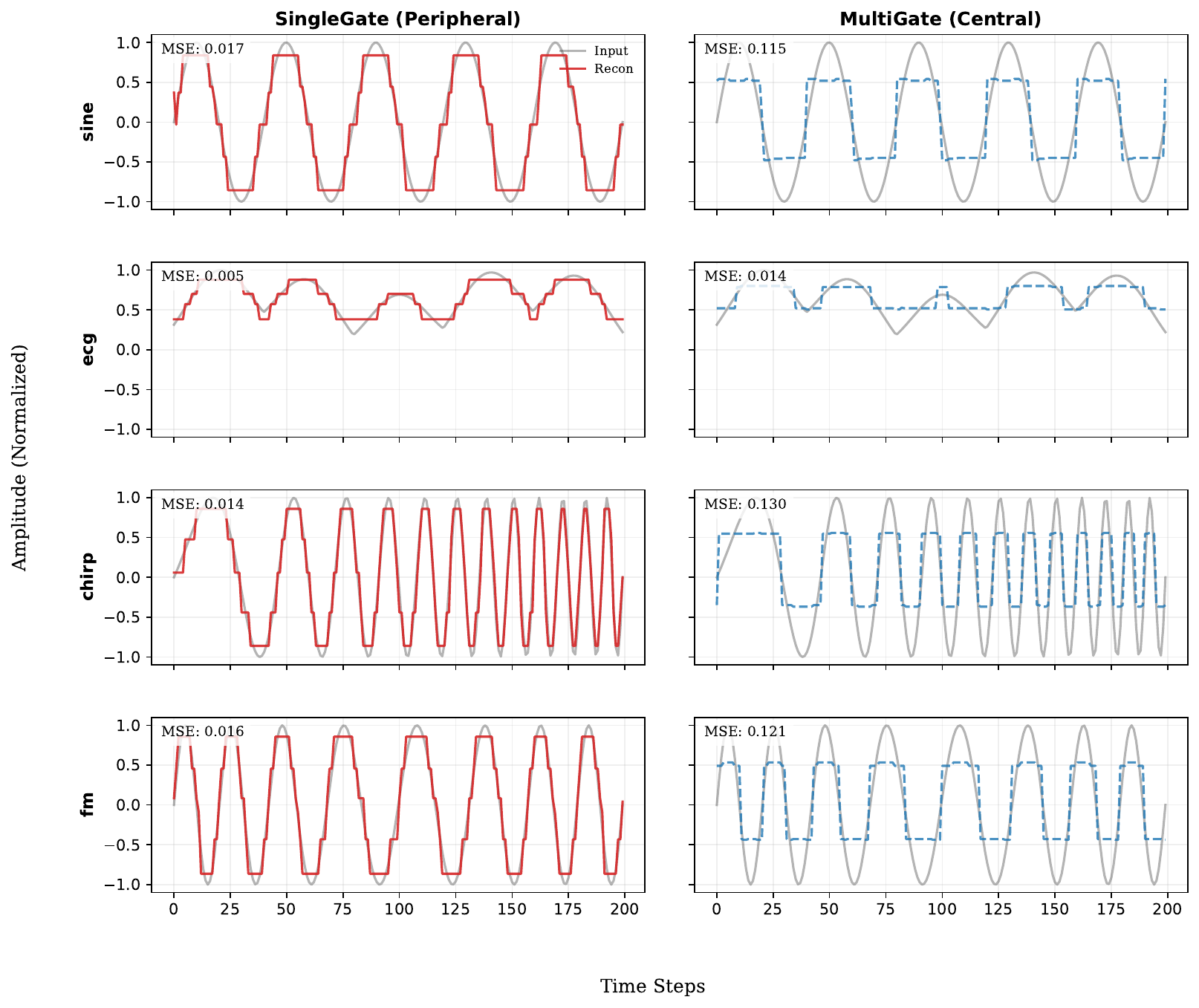
Left column (SingleGate): Robust phase-locking and stable discretization (red) accurately tracking input (gray). Right column (MultiGate): Fails to capture signal structure, resulting in collapsed representations (blue dashed).
Convergence Dynamics:
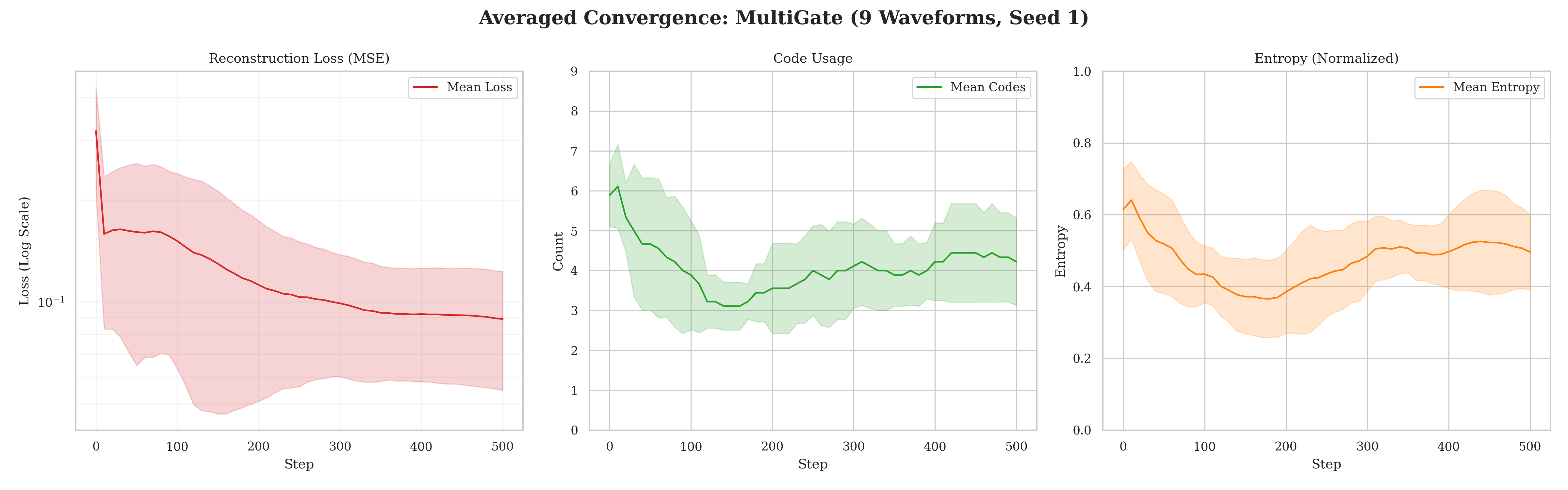
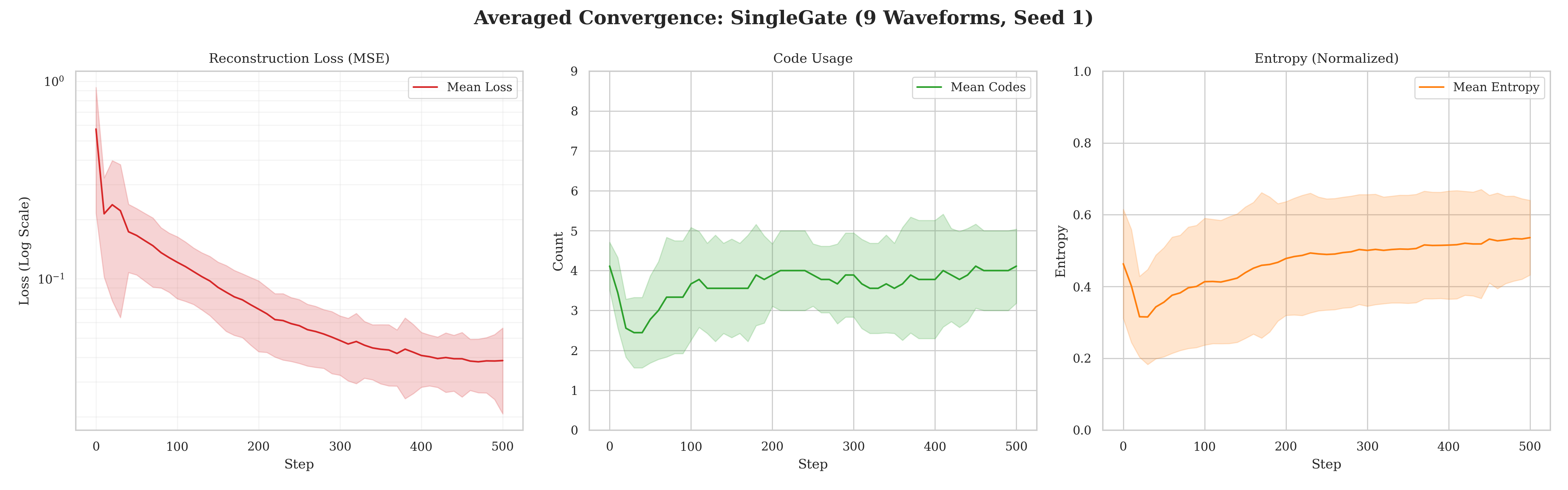
Key Findings
Both architectures produce comparable discrete-state statistics (transition rate, code usage, entropy), confirming that Axioms A2–A3 suffice for discretization. However, MultiGate substantially worsens reconstruction (large effect size), demonstrating that routing capacity is unnecessary and detrimental when no relational ambiguity exists.
EX2 — Multi-Channel Relational Information
Purpose
EX2 validates the necessity of MultiGate architecture for processing multi-channel signals with time-varying relationships. This tests whether independent gating is required when channels exhibit asynchronous dynamics.
Hypotheses
- H1 (Failure of Shared Clock): SingleGate will fail to accurately reconstruct dual-channel signals with varying frequency ratios.
- H2 (Success of Independent Gating): MultiGate can assign distinct update timings to each channel.
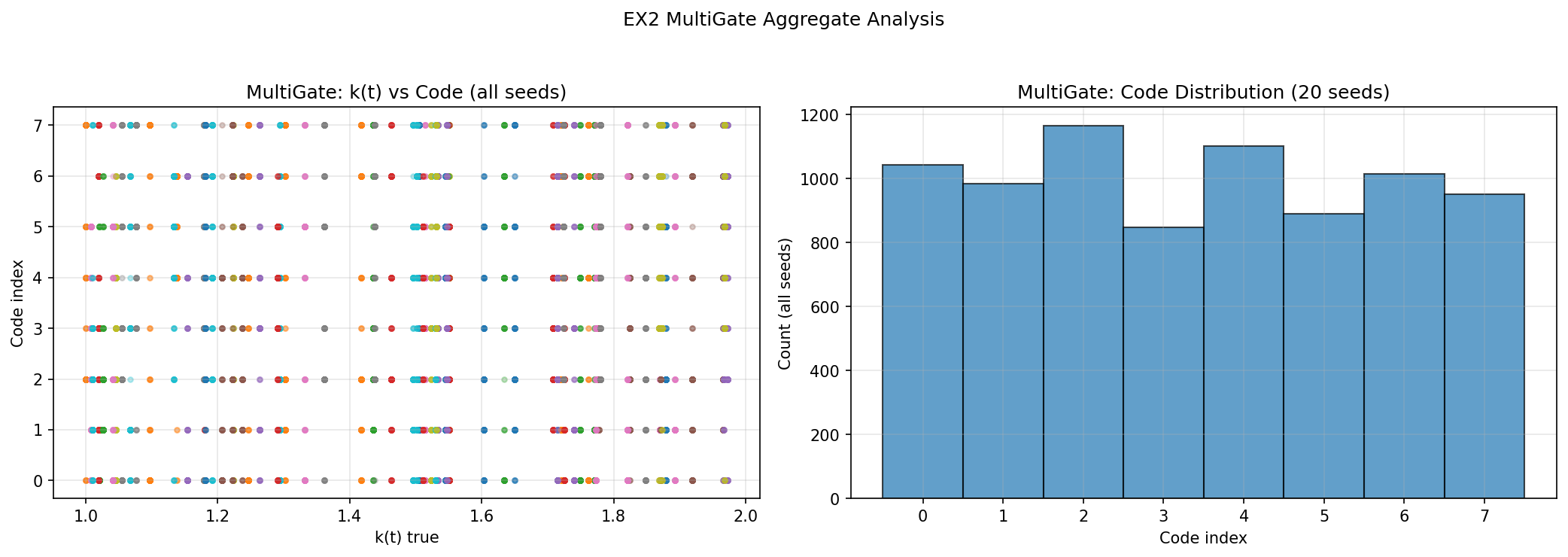
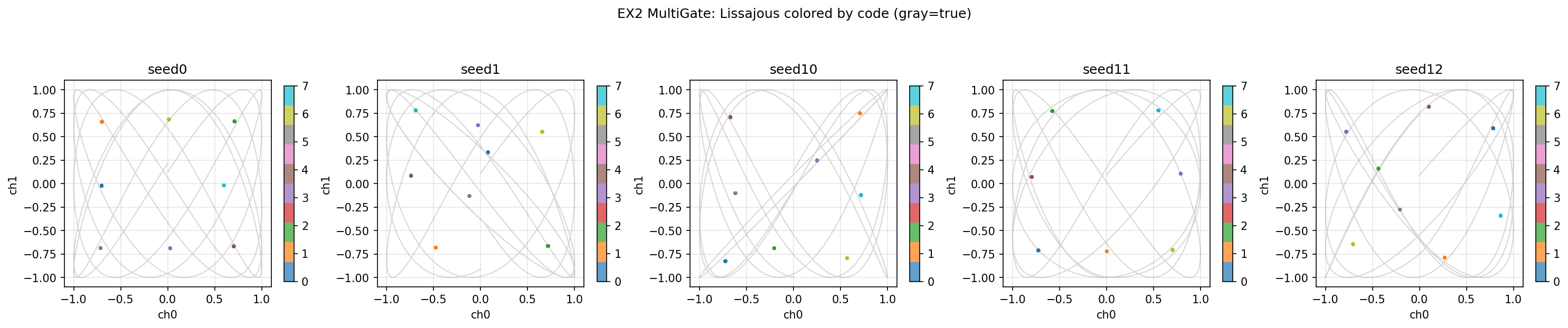
- H3 (Relational Encoding): The combination of discrete codes will implicitly encode the frequency ratio k(t).
Task Design
Dual-channel dataset coupled by time-varying frequency ratio k(t):
- Channel 0 (Reference): $x_0(t) = \sin(2\pi f_0 t)$
- Channel 1 (Target): $x_1(t) = \sin(\int_0^t 2\pi f_0 k(\tau) d\tau)$
- Relational Parameter: k(t) ∈ [1.0, 2.0], piecewise constant (4 segments)
Method
| Parameter | Value |
|---|---|
| Anchor Configuration | Reference anchor (y = x₀) |
| Codebook Size (K) | 8 |
| Sequence Length (T) | 400 |
| Training Steps | 1500 |
| Base Frequency (f₀) | 5.0 Hz |
| Seeds | 20 per condition |
Results
| Architecture | Recon. Loss | Unique Codes | Code Entropy |
|---|---|---|---|
| MultiGate | 0.063 ± 0.007 | 7.85 ± 0.36 | 0.920 ± 0.042 |
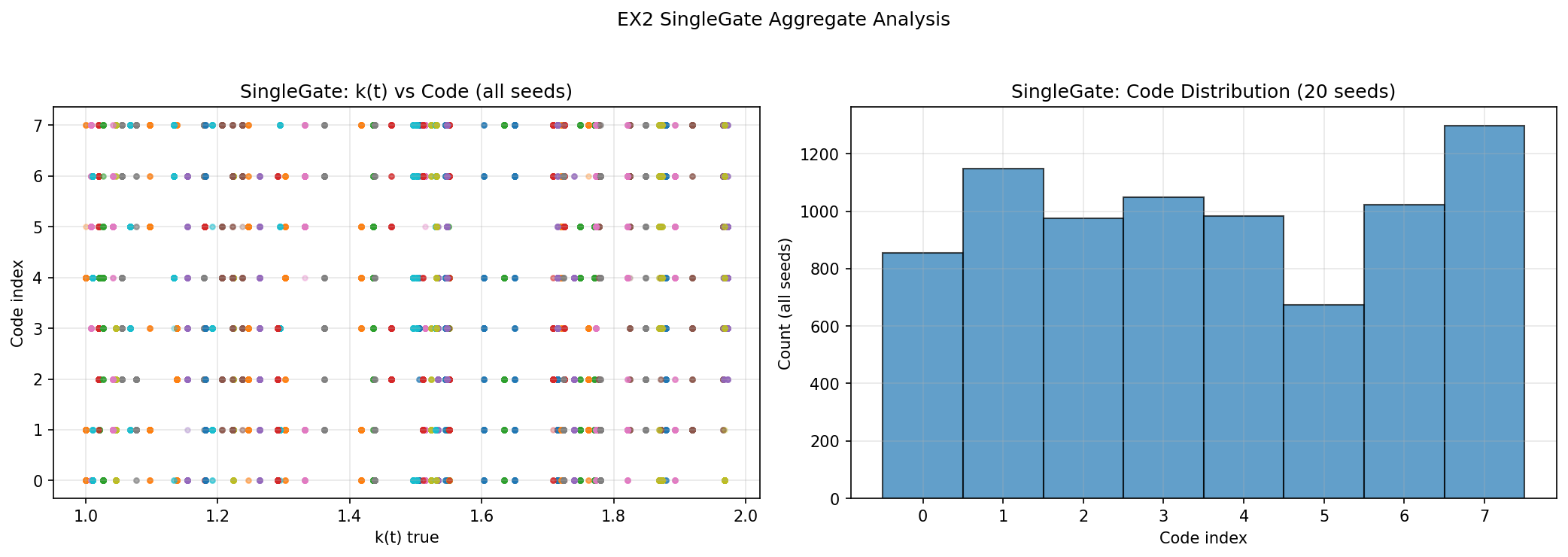
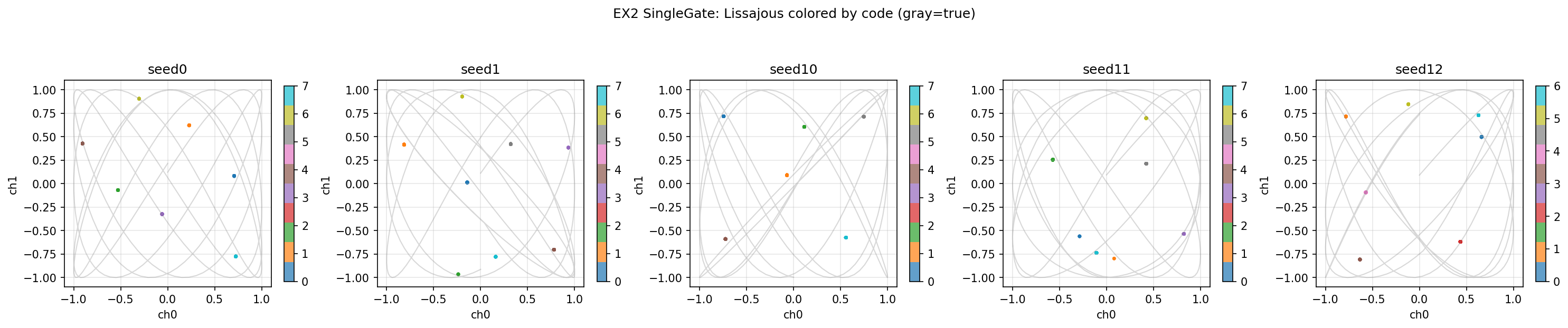
| SingleGate | 0.171 ± 0.039 | 6.85 ± 0.57 | 0.846 ± 0.051 |
Paired difference: ΔRecon = −0.108 (95% CI [-0.127, -0.090]), d_z = −2.561
Visual Analysis
Key Findings
Double Dissociation: SingleGate excels at single-channel tasks (EX1) while MultiGate excels at relational tasks (EX2). This validates the functional division: peripheral processing (SingleGate) for stable integration, central processing (MultiGate) for relational abstraction.
EX3 — K-Dependency Analysis
Purpose
EX3 investigates the geometric nature of discretization. Does CSCT perform “Lebesgue-like” integration (partitioning value/amplitude space) rather than “Riemann-like” integration (partitioning time domain)?
Hypotheses
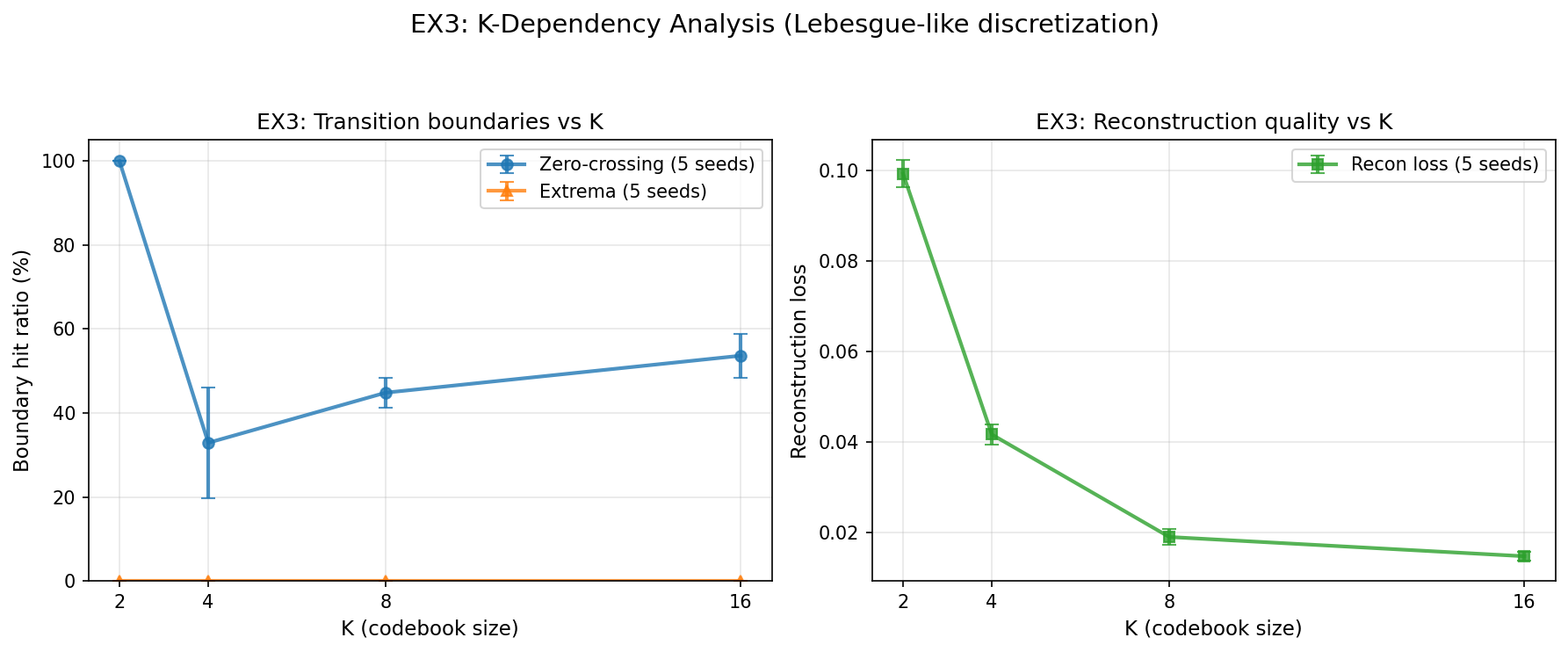
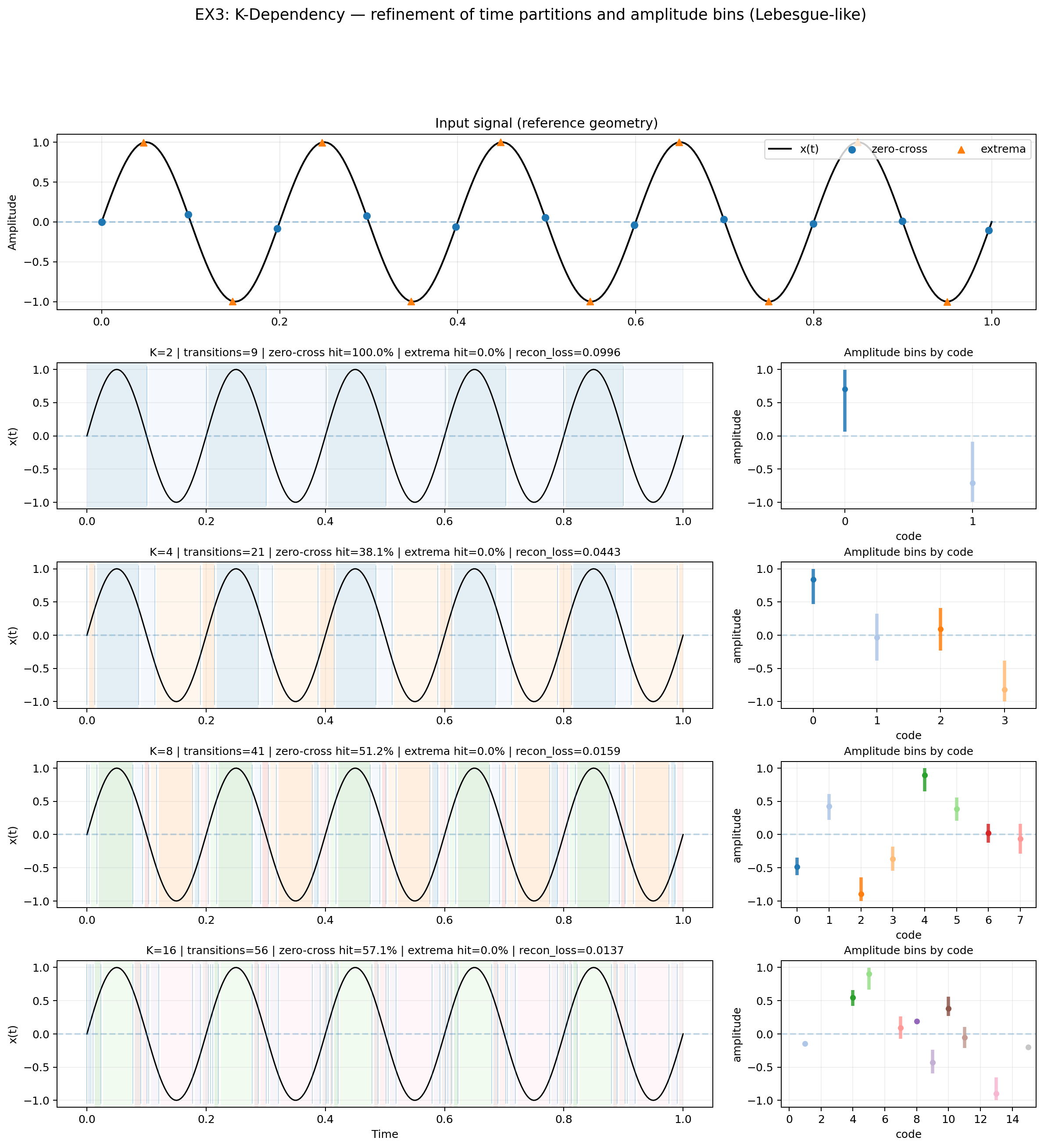
- H1 (K=2, Sign Detection): Minimal capacity captures signal sign; transitions align with zero-crossings.
- H2 (Lebesgue-like Partitioning): For K>2, system partitions amplitude range into discrete bins.
- H3 (Velocity Constraint): Transitions are discouraged near extrema (where velocity ≈ 0).
Method
| Parameter | Value |
|---|---|
| Architecture | SingleGate |
| Input | Pure sine wave (f₀ = 5.0 Hz) |
| Codebook Size (K) | {2, 4, 8, 16} |
| Sequence Length (T) | 300 |
| Training Steps | 2000 |
| Seeds | 20 per K |
Results
| K | Recon. Loss | Transitions | Zero-Cross Ratio | Extrema Ratio |
|---|---|---|---|---|
| 2 | 0.101 ± 0.004 | 10.2 ± 0.8 | 1.000 | 0.000 |
| 4 | 0.041 ± 0.004 | 21.8 ± 2.6 | 0.438 | 0.000 |
| 8 | 0.021 ± 0.005 | 36.6 ± 3.4 | 0.449 | 0.000 |
| 16 | 0.015 ± 0.002 | 48.0 ± 4.0 | 0.546 | 0.000 |
Visual Analysis
Key Findings
- K=2: 100% of transitions occur at zero-crossings (sign detection)
- All K: 0% of transitions occur at extrema (velocity constraint confirmed)
- Reconstruction improves monotonically with K (capacity-driven refinement)
The system performs value-space partitioning (Lebesgue-like), not time-domain sampling (Riemann-like).
EX4 — Anchor Role (Noise Floor vs. Drift)
Purpose
EX4 examines the trade-off between short-term accuracy (noise filtering) and long-term stability (drift prevention) in anchored vs. autonomous systems.
Hypotheses
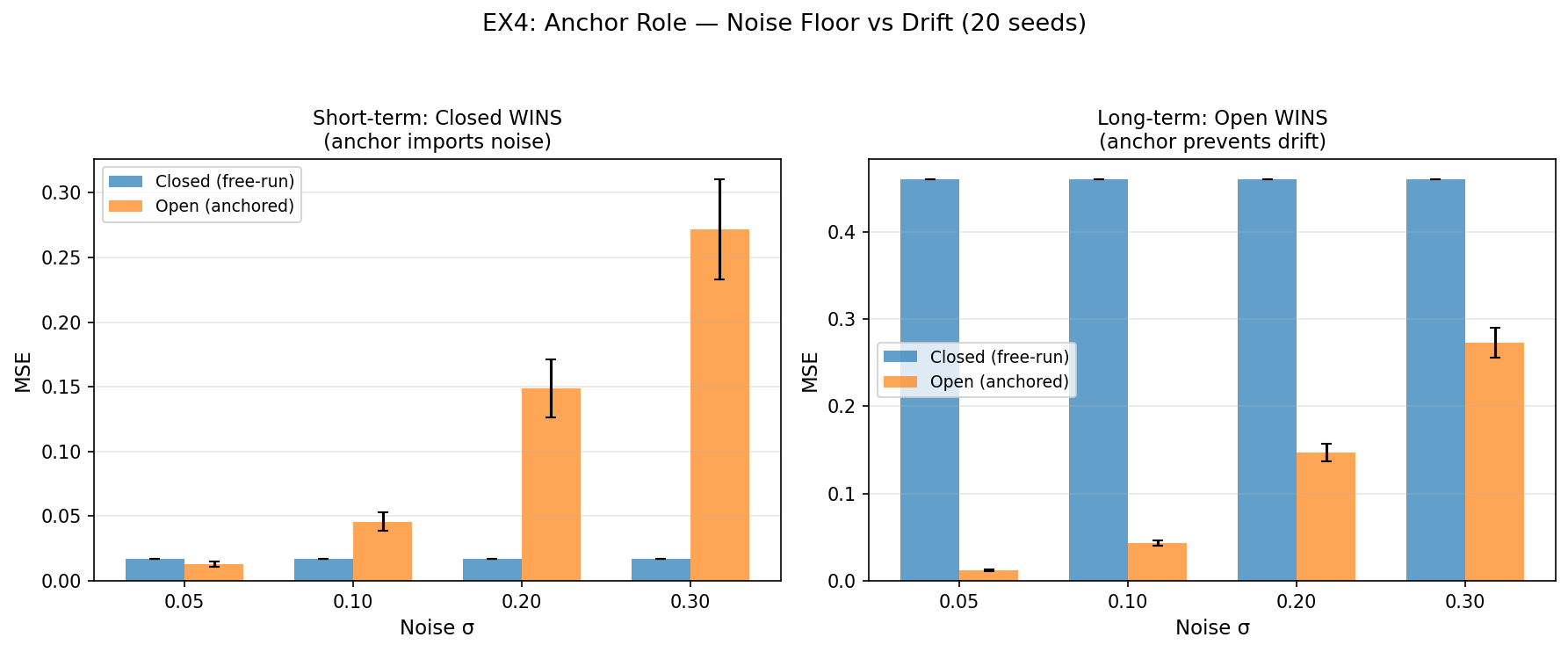
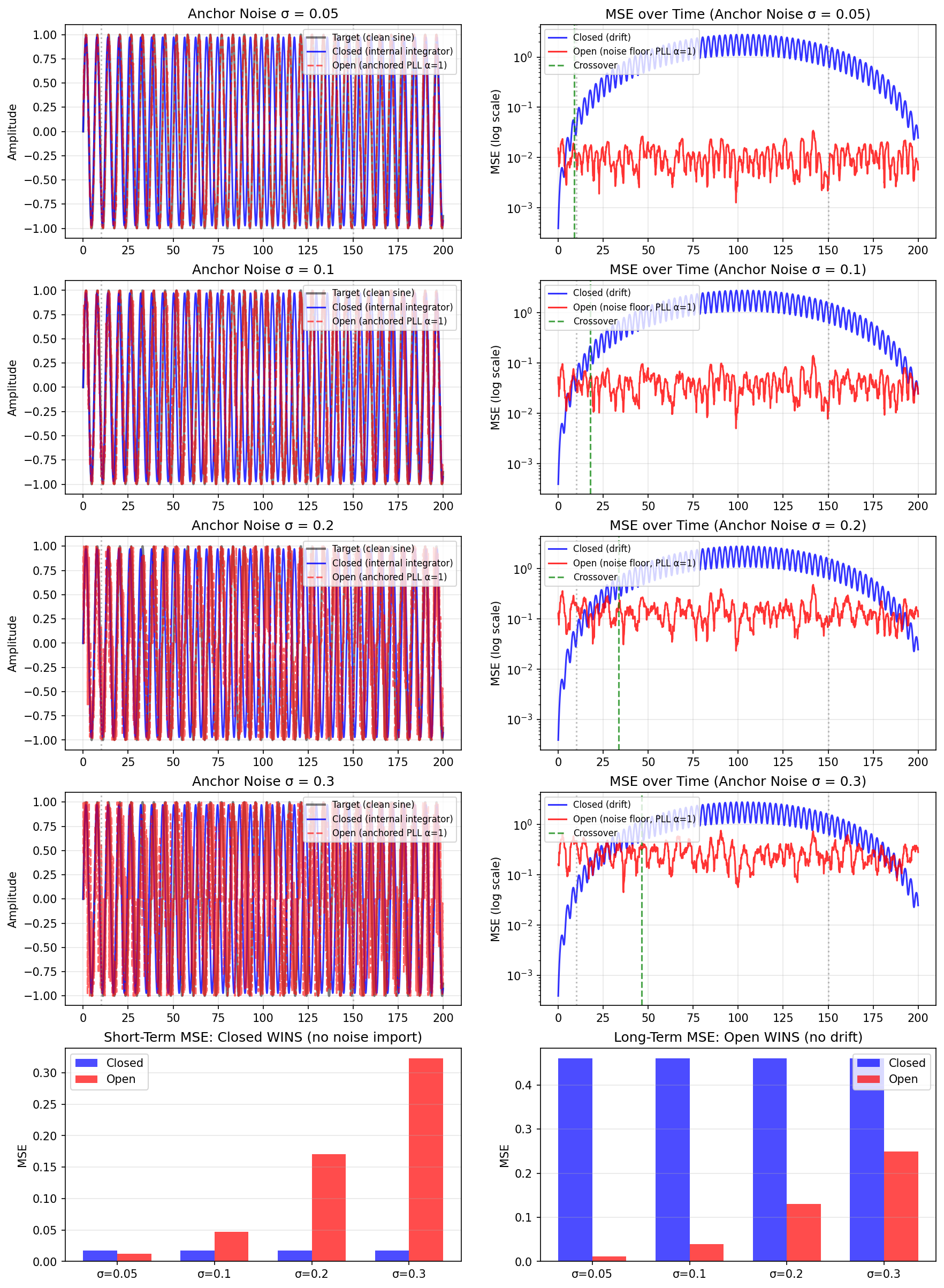
- H1 (Short-term Noise Cost): Closed system shows lower error initially due to noise filtering.
- H2 (Long-term Drift Prevention): Open system shows lower error long-term due to drift prevention.
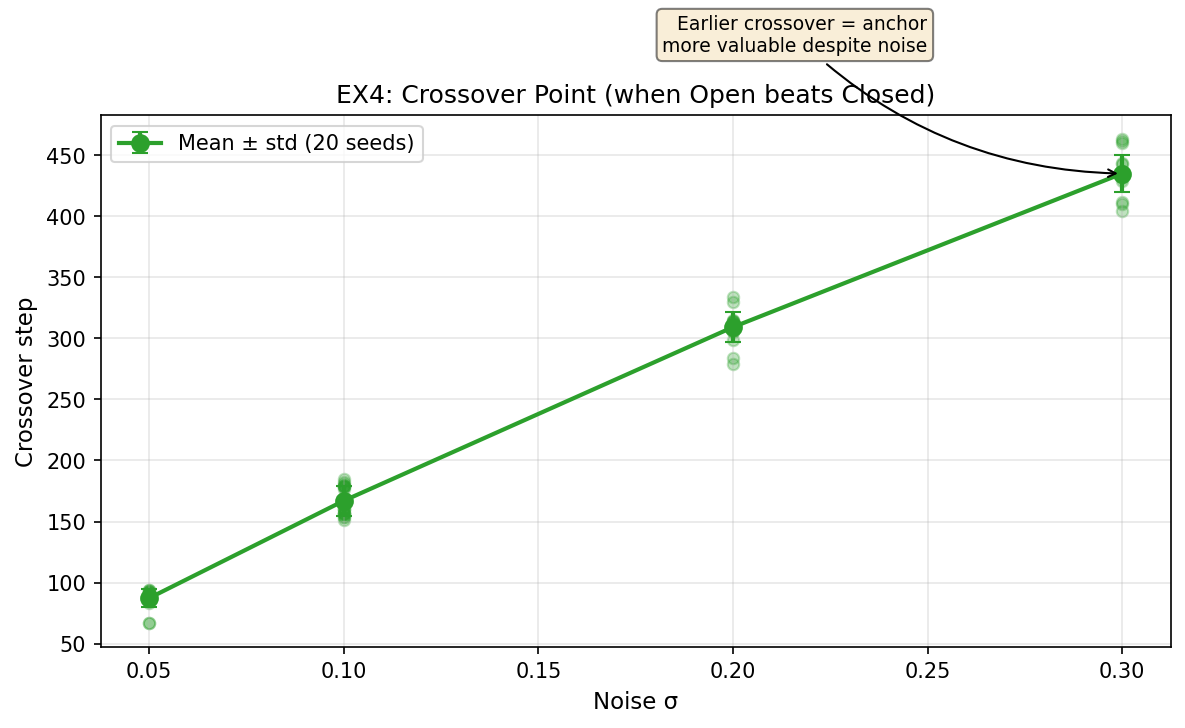
- H3 (Crossover Point): A crossover T_cross exists, increasing with noise σ.
Task Design
- Target: Sine wave x(t) = sin(t)
- Internal Model Imperfection: 3% frequency error (accumulates drift)
- Anchor: Noisy sawtooth y(t) = saw(t) + N(0, σ²)
- Conditions: σ ∈ {0.05, 0.10, 0.20, 0.30}
Results
| Noise (σ) | Short MSE (Closed) | Short MSE (Open) | Long MSE (Closed) | Long MSE (Open) | T_cross |
|---|---|---|---|---|---|
| 0.05 | 0.017 | 0.013 | 0.460 | 0.012 | 87 |
| 0.10 | 0.017 | 0.046 | 0.460 | 0.043 | 167 |
| 0.20 | 0.017 | 0.149 | 0.460 | 0.147 | 309 |
| 0.30 | 0.017 | 0.272 | 0.460 | 0.273 | 435 |
Visual Analysis
Key Findings
- Short-term: Closed system wins when σ ≥ 0.10 (noise filtering advantage)
- Long-term: Open system wins across all noise levels (drift prevention)
- Crossover: T_cross scales with σ (lower noise → earlier crossover → anchor more valuable)
Irreversible anchors provide long-term stability, not immediate accuracy.
EX5 — Binding Problem
Purpose
EX5 tests whether a shared anchor clock can preserve relative phase relationships between modules despite independent frequency drifts, solving the classic “binding problem.”
Hypotheses
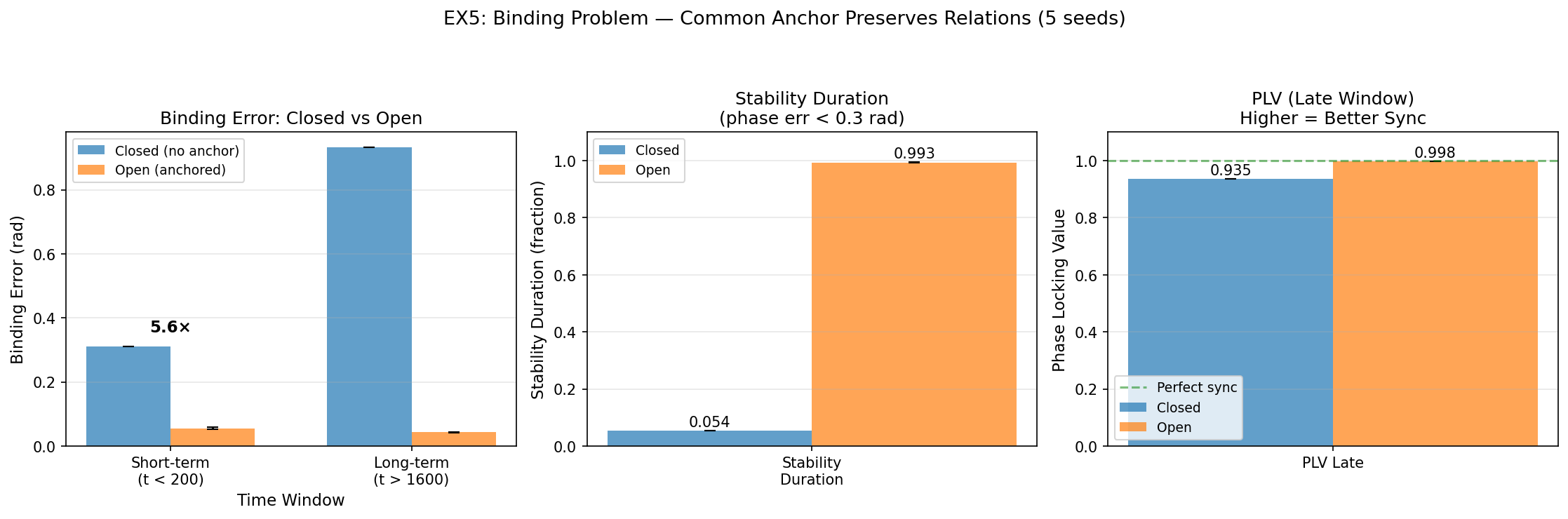
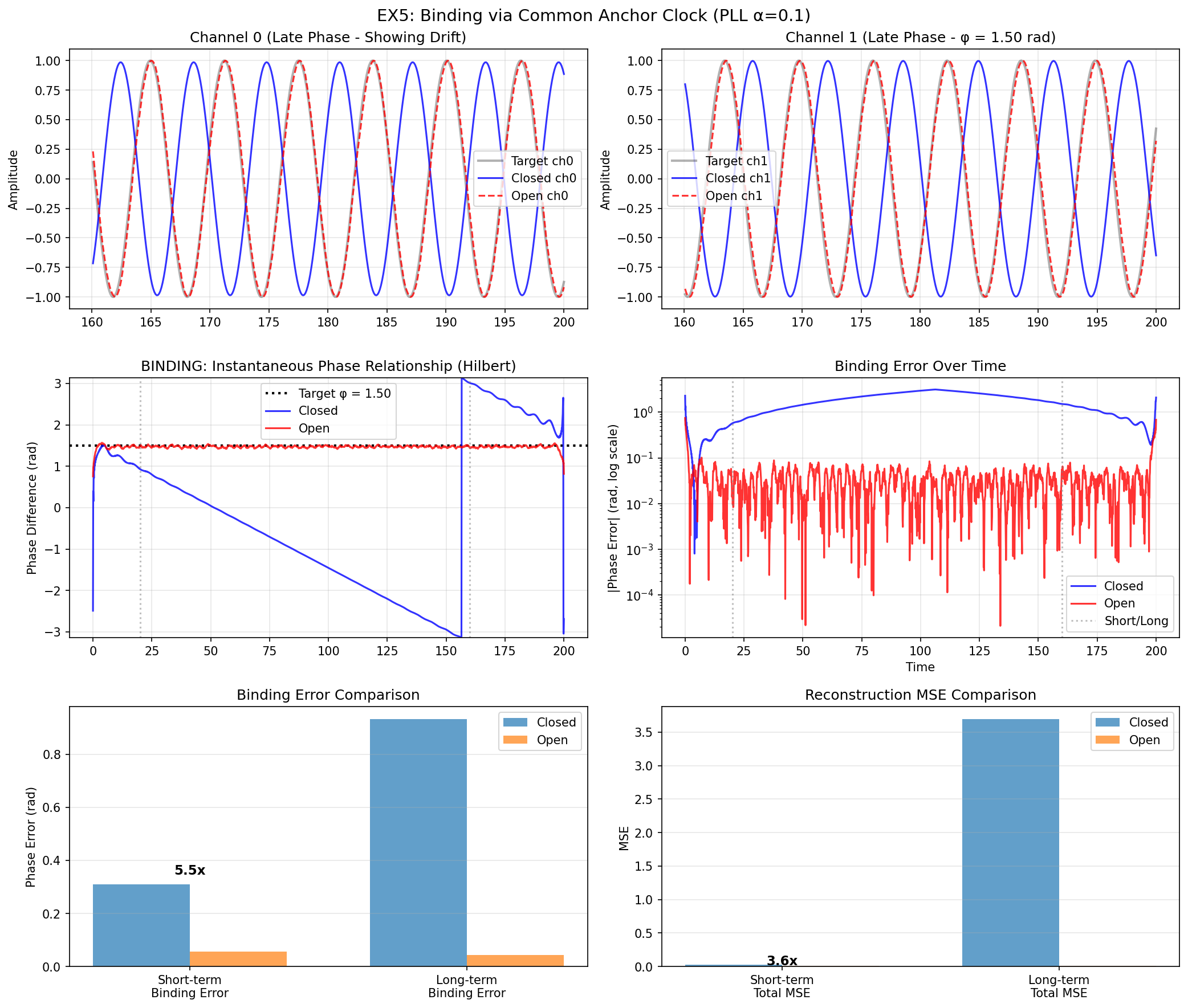
- H1 (Unbounded Drift without Anchor): Relative phase error grows unbounded without shared reference.
- H2 (Bounded Error with Anchor): Relative phase error remains bounded with shared anchor.
Task Design
- Target Signals: Two sine waves with fixed phase offset (φ = 1.5 rad)
- Drift Condition: ±1.5% frequency error in opposite directions
- Anchor Noise: σ = 0.1 rad
Results
| Condition | MSE (Early) | MSE (Late) | Stability Duration | PLV (Late) |
|---|---|---|---|---|
| Open | 0.008 | 0.009 | 1.000 | 0.998 |
| Closed | 0.024 | 3.697 | 0.054 | 0.935 |
Visual Analysis
Key Findings
Binding can emerge from shared temporal reference without direct inter-module communication. The shared anchor acts as “temporal glue,” synchronizing internal clocks to preserve relational structure.
EX6 — Frozen-Code Category Recognition
Purpose
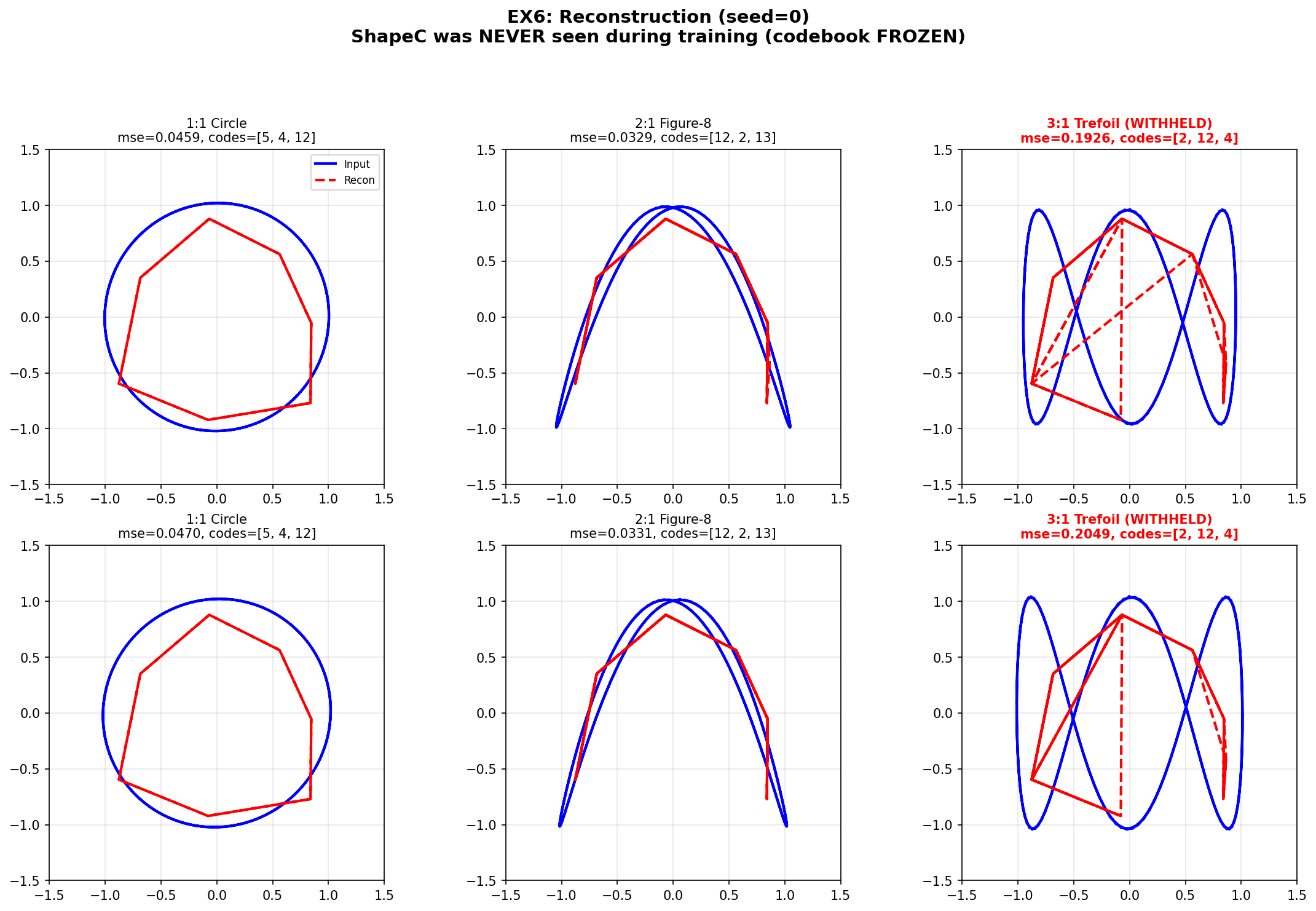
EX6 tests whether new inference can occur after learning is stopped. A MultiGate model is trained on a subset of Lissajous categories, then the codebook is frozen. Can it detect a withheld category?
Task Design
| Shape | Frequency Ratio | Status |
|---|---|---|
| ShapeA (Circle) | 1:1 | Trained |
| ShapeB (Figure-8) | 2:1 | Trained |
| ShapeC (Trefoil) | 3:1 | Withheld |
Method
| Parameter | Value |
|---|---|
| Architecture | MultiGate |
| Codebook Size (K) | 16 |
| Training Steps | 2000 |
| Seeds | 50 |
Results
| Metric | Trained Shapes | Withheld Shape |
|---|---|---|
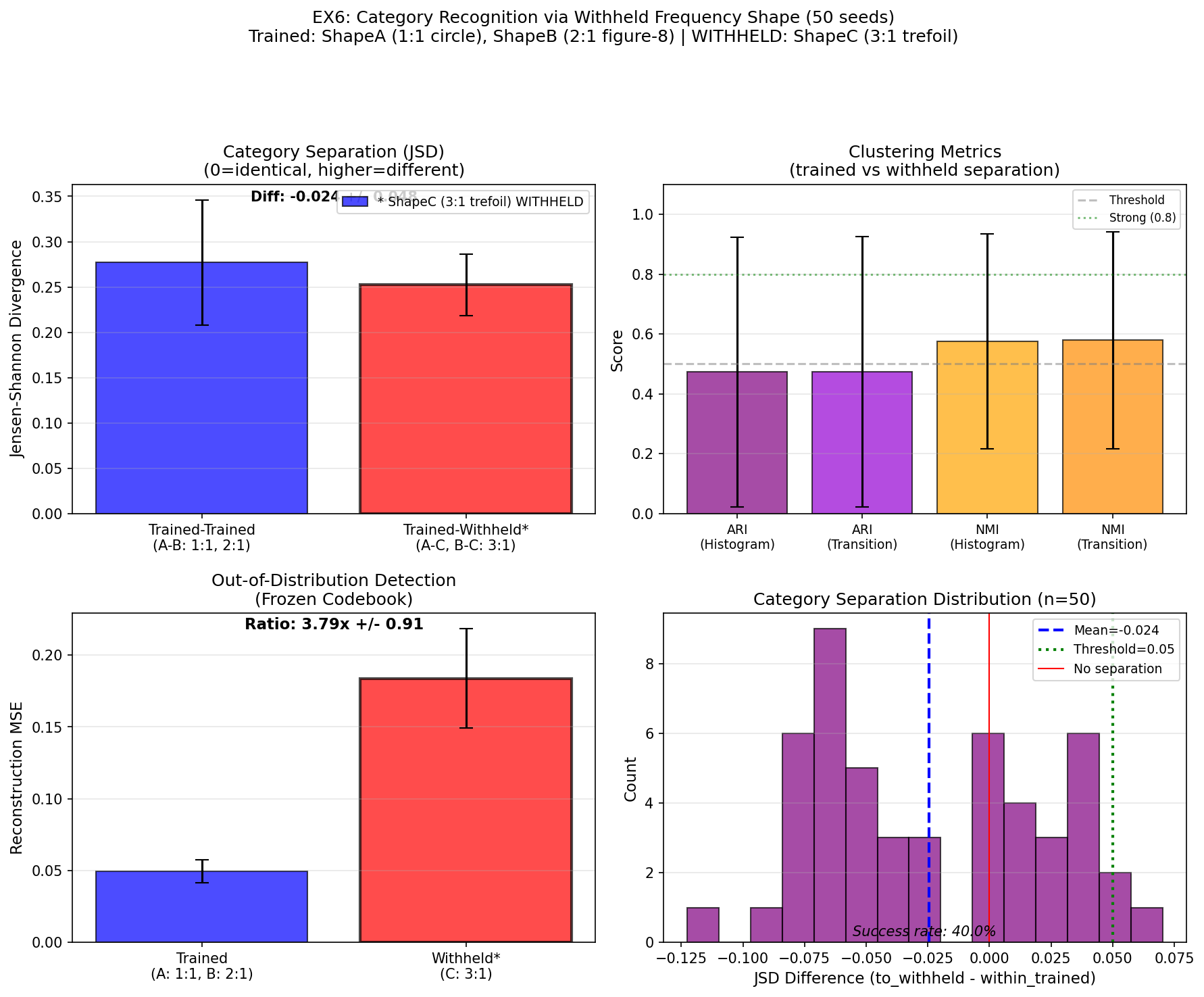
| MSE | 0.050 ± 0.008 | 0.184 ± 0.035 |
| MSE Ratio | — | 3.79× ± 0.91 |
| Detection Success | — | 100% (50/50) |
JSD (within-trained vs. to-withheld): ΔJSd = −0.024 ± 0.048 (not discriminative)
Visual Analysis
Key Findings
- MSE ratio provides robust OOD detection (100% success, all seeds > 2.0×)
- JSD fails to distinguish withheld from trained categories (codebook reuse phenomenon)
- Ungrounded Symbol Acquisition: Codes are assigned but lack reconstructable meaning outside the convex hull
EX7 — Relational Internal Time
Purpose
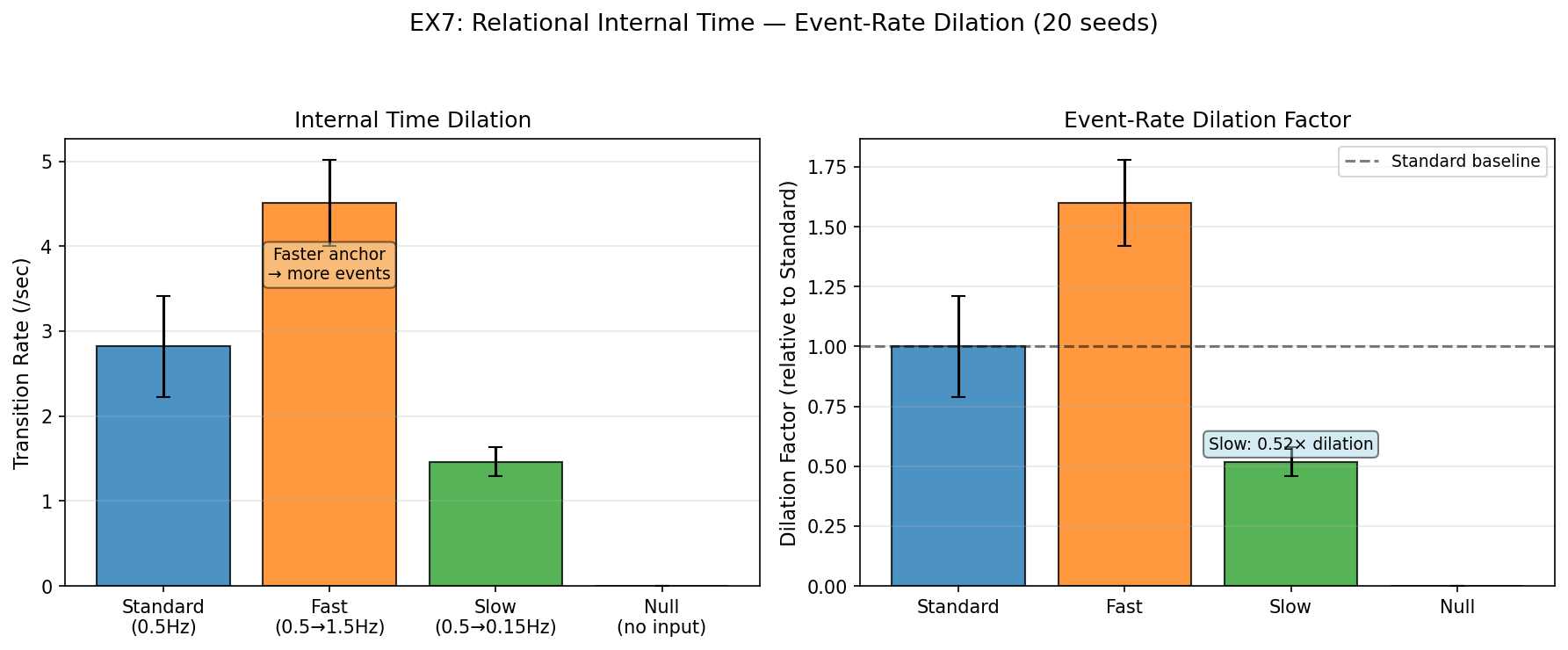
EX7 examines whether internal time (measured as transition rate) scales with external anchor tempo—testing that subjective time is flux-driven, not absolute.
Task Design
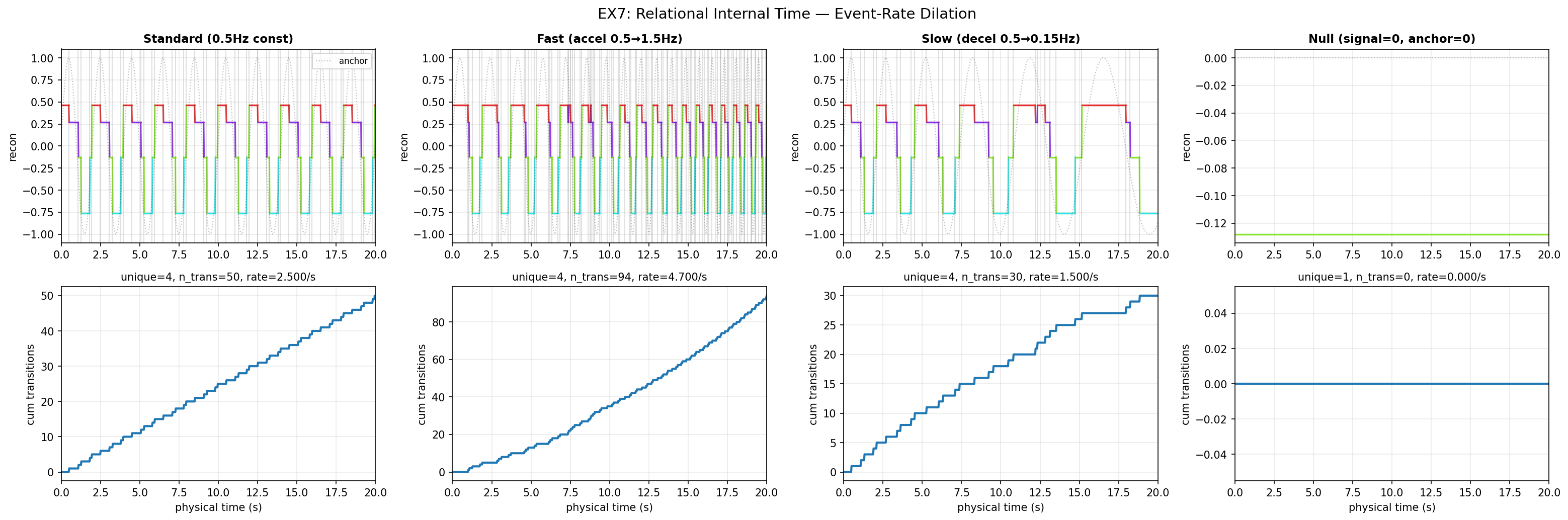
Train once on “Standard World” (f₀ = 0.5 Hz), then deploy (frozen weights) to:
- Standard: 0.5 Hz (baseline)
- Fast: 0.5 → 1.5 Hz (3× acceleration)
- Slow: 0.5 → 0.15 Hz (0.3× dilation)
- Null: No input (zero signal)
Results
| World | Unique Codes | Transitions | Trans./sec | Dilation Factor |
|---|---|---|---|---|
| Fast | 4.00 | 90.2 ± 9.9 | 4.51 ± 0.49 | 1.60× |
| Standard | 4.00 | 56.4 ± 11.5 | 2.82 ± 0.58 | 1.00× |
| Slow | 4.00 | 29.3 ± 3.3 | 1.47 ± 0.17 | 0.52× |
| NULL | 1.00 | 0.0 | 0.00 | — |
Visual Analysis
Key Findings
- Content invariance: Same 4 codes used across all non-null worlds
- Duration adaptation: Transition rate scales with environmental tempo
- Null halt: Internal time stops when input flux = 0
The system processes “change,” not “time”—a form of cognitive relativity.
EX8 — Semantic Grounding via Convex Hull
Purpose
EX8 investigates whether semantic grounding requires geometric compatibility within the learned simplex (Axiom A2). Can a withheld primitive be inferred after codebook freezing?
Task Design
Training: {A, B, A+B, A+C, B+C} — Primitive C never shown alone
Test (Frozen): Can the model reconstruct C using only the anchor?
Geometric Conditions:
- IN_HULL: C = αA + (1−α)B (inside convex hull)
- RANDOM: C randomly initialized
- OUT_HULL: C ⊥ A, C ⊥ B (orthogonal = outside hull)
Results
| Condition | Withheld Similarity | Success Rate | Unique Code Acquisition |
|---|---|---|---|
| IN_HULL | 0.979 ± 0.025 | 96.7% (29/30) | 96.7% |
| RANDOM | 0.682 ± 0.370 | 53.3% (16/30) | 66.7% |
| OUT_HULL | 0.701 ± 0.242 | 16.7% (5/30) | 80.0% |
Statistical significance: Kruskal–Wallis H = 42.52, p = 5.85 × 10⁻¹⁰
Key Findings
- Convex hull membership determines grounding: IN_HULL achieves near-perfect recovery
- OUT_HULL demonstrates Ungrounded Symbol Acquisition: 80% acquire unique codes, but only 16.7% succeed in reconstruction
- The code is manipulated, but lacks reconstructable meaning—a mathematical instantiation of the Chinese Room argument
EX9 — Syntax Inference via Barycentric Interpolation
Purpose
EX9 tests whether syntactic inference can arise once meaning has been discretized. Can a system infer an unseen composition rule under reconstruction-only learning?
Task Design
Training: {A, B, C, A+B, A+C} — Composite B+C withheld
Test (Frozen): Can the model reconstruct B+C?
Results
| Condition | Withheld Similarity (B+C) | Success Rate |
|---|---|---|
| IN_HULL | 0.890 ± 0.138 | 66.7% (20/30) |
| RANDOM | 0.767 ± 0.253 | 33.3% (10/30) |
| OUT_HULL | 0.742 ± 0.168 | 13.3% (4/30) |
Statistical significance: Kruskal–Wallis H = 19.13, p = 7.00 × 10⁻⁵
Key Findings
- Syntax emerges as barycentric interpolation: The system learns $f: y_{B+C} \mapsto \frac{1}{2}v_B + \frac{1}{2}v_C$
- Unlike meaning (EX8), syntax benefits from geometric scaffold even when withheld primitive is outside hull
- But performance still degrades in OUT_HULL, confirming syntax remains geometrically constrained
Summary Table
| Exp. | Task | Key Finding | Axiom |
|---|---|---|---|
| EX1 | Single-channel discretization | SingleGate suffices for self-anchored simple signals | A1 |
| EX2 | Two-channel relation | MultiGate superior for complex relational dynamics | A3 |
| EX3 | Codebook size dependency | K-dependency follows Lebesgue-like geometry | A2 |
| EX4 | Noise vs. drift | Irreversible anchors provide long-term stability | A4 |
| EX5 | Feature binding | Common clock solves binding without concatenation | A3 |
| EX6 | Category recognition | MSE ratio detects novel categories (100% success) | A2 |
| EX7 | Relational time | Internal tempo emerges from flux dynamics | A3 |
| EX8 | Semantic grounding | Meaning requires convex-hull membership (96.7% vs 16.7%) | A2 |
| EX9 | Syntax inference | Syntax emerges via barycentric interpolation (66.7% vs 13.3%) | A5 |
For full details, see the manuscript: 10.5281/zenodo.18408862